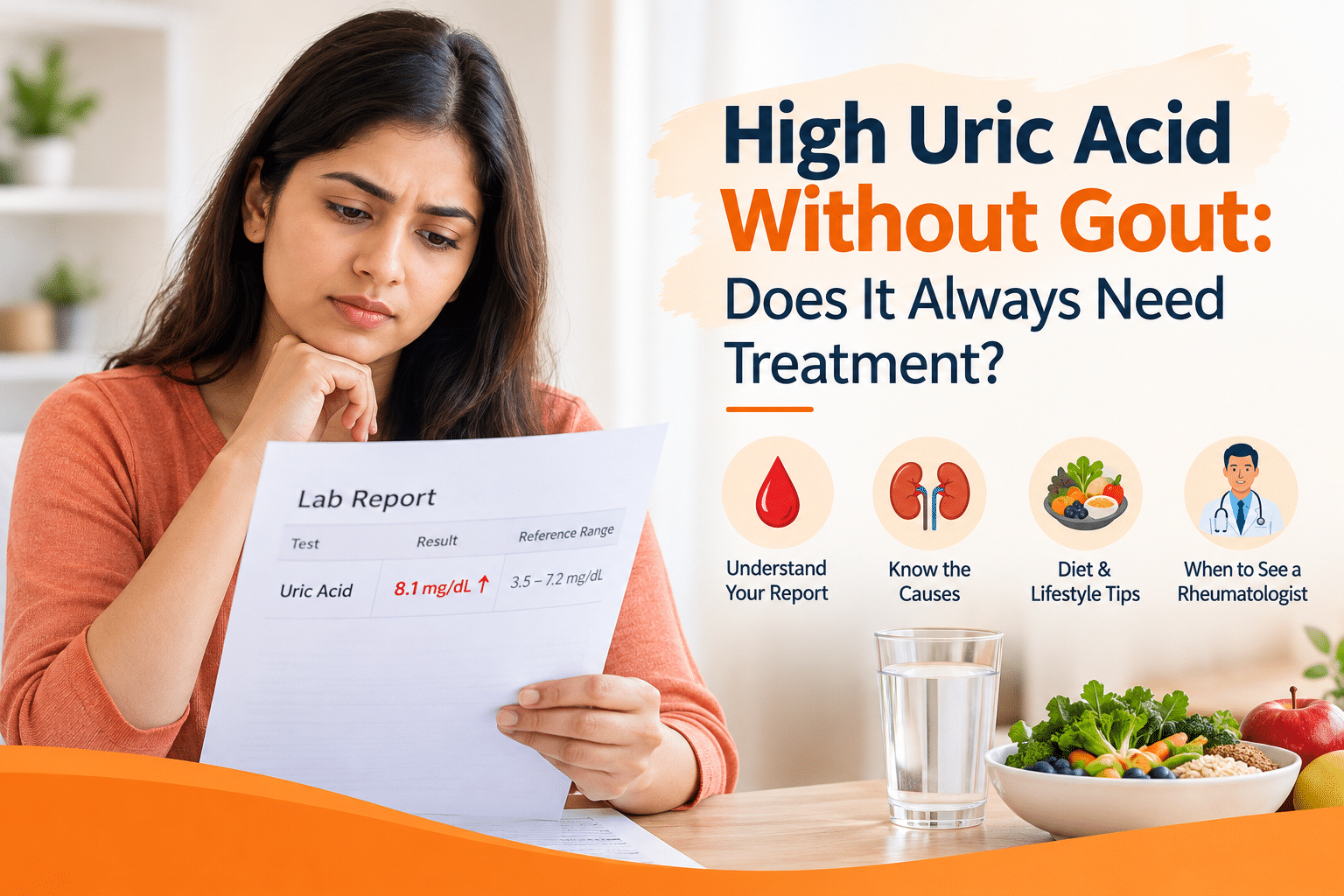
Picture this. Your annual health check-up report lands in your inbox and one number is highlighted in red: uric acid 8.1 mg/dL. No swollen toe. No knee pain. You took the stairs this morning without a second thought. And yet the report says “high,” and somebody in the family WhatsApp group has already forwarded a home remedy.
If that’s you, you have high uric acid without gout. It’s a very common finding in Mumbai, Navi Mumbai, Vashi and Panvel, and it worries people more than it needs to. So does it always need treatment? No. Doctors call it asymptomatic hyperuricemia: a raised blood level, but no gout attacks, no kidney stones, nothing else going on so far. Whether you need medicines depends on your whole health picture, and one lab value can’t decide that on its own.
Here’s how to read your report, why the number goes up, and what to do about it.
Table of Contents
ToggleStart with what uric acid actually is. When your body breaks down purines (chemicals found in your own cells and in plenty of food), uric acid is left over as waste. It dissolves in the blood, the kidneys filter most of it into urine, and a little leaves through the gut.
Hyperuricemia is the term for a blood level above what’s expected. Either your body is making a lot of uric acid, or your kidneys are slow at clearing it. For most people it’s the kidneys.
Here’s the part that gets lost. A high level on a report is a lab finding. Gout is a disease, where urate crystals lodge in a joint and set off painful inflammation. Lots of people have the first and never meet the second.
What counts as normal depends on the lab. Many Indian labs print roughly 3.5 to 7.2 mg/dL for men and 2.5 to 6.0 mg/dL for women. Women often sit lower before menopause because oestrogen helps the kidneys flush urate out. Go by the range printed on your own report, since that’s the one your lab used.
You’ll also see 6.8 mg/dL mentioned a lot. At body temperature, blood can hold urate in solution up to about that point. Beyond it, crystals can start forming, mostly in cooler joints like the big toe. Can, not will. So a normal uric acid level is a reference range and nothing more, and no single uric acid level works as a treatment trigger for everybody.
Think of two people. One has 8.2 and has never felt anything. The other has 6.9 and has had three joint attacks this year. Which one needs the longer conversation with a doctor? Probably the second, even though the first number is higher.
Asymptomatic high uric acid is easy to describe. The blood test is abnormal and you feel fine.
Why no symptoms? Crystals take time, and they need the right conditions, sometimes a trigger as well. Some people carry a raised level for years and never form deposits. Others get gout at fairly modest levels. Nobody can predict perfectly who ends up where, which is why one number is a poor fortune-teller.
An abnormal test isn’t a diagnosis either. High uric acid but no gout is something to understand, not something to lose sleep over. It shouldn’t be waved away, though. The level can hint at how your kidneys are doing, or at your weight, blood pressure, medicines and food habits, so a quick review is worth the time.
People want one culprit. Usually there are several.
Kidneys come first. Even a mild dip in kidney function can slow uric acid clearance long before you’d notice anything. Genes come next: if your parents or siblings have high uric acid or gout, you’re more likely to have it too, whatever you eat.
Then food and drink, where most of the blame lands. Organ meats like liver, plenty of red meat, and seafood such as sardines and anchovies add purines. Beer is the best-known offender, and spirits contribute too. Cold drinks and packaged fruit juice matter more than people expect, because of their fructose.
Body weight, blood pressure, diabetes and high triglycerides tend to travel together with a raised level. Dehydration plays a part (too little water, or sweating a lot and not topping up). Some medicines push uric acid up, including water tablets, low-dose aspirin and certain anti-TB drugs, and so do hypothyroidism, psoriasis and chronic kidney disease. Those are the usual high uric acid causes, and the same list is what a doctor runs through when hunting for the causes of high uric acid in one particular person.
If you’re on regular medicines, don’t stop them because of a uric acid report. Ask the doctor who prescribed them first.
Here’s the awkward truth about uric acid symptoms: mostly there aren’t any. That’s why so many people find out by accident. If you were hoping to spot high uric acid symptoms by how you feel, you can’t, at least not from the number alone.
What you do notice comes from complications. A gout attack hits suddenly, often at night, with severe joint pain, swelling, heat, redness and tenderness. It can be so intense that even a bedsheet on the toe hurts. The big toe is the classic spot, but ankles, knees, wrists and fingers get it too.
Kidney stones feel different: severe pain in the side or back that comes in waves, blood in the urine, burning while passing urine. That needs prompt medical attention.
One more thing, because “it’s the uric acid” has become the default explanation for every ache in India. Aching joints can come from osteoarthritis, rheumatoid arthritis or an infection. Symptoms can’t confirm a high uric acid level. Only a blood test can, and a doctor has to read the test together with the joint.
Sometimes, yes. Not always.
If uric acid stays high long enough, needle-shaped urate crystals can form in and around a joint. Your immune system reacts to them, and that reaction is the gout attack.
With high uric acid and gout, think probability. The higher the level and the longer it stays there, the likelier an attack. But plenty of people with raised levels never get one, so gout isn’t a given. Age, sex, family history, kidney function, alcohol, medicines and weight all shift the odds.
Take stones first. Uric acid and kidney stones are connected, though not in every case. When uric acid stays high and the urine is acidic and concentrated, uric acid stones can form, more so in people who’ve had stones before. Plenty of stones are calcium-based, with different causes.
High uric acid and kidney disease is messier. The two show up together, and it’s hard to say which pushes which. Weak kidneys hold on to uric acid, and very high uric acid may stress the kidneys in return. Large trials of allopurinol in people with chronic kidney disease didn’t show that it slowed kidney decline. That’s one reason current guidance doesn’t back treating a raised number alone to protect the kidneys.
So among high uric acid complications, kidney trouble is real but not guaranteed. Your kidney function, your history and your other risks weigh far more than the uric acid value by itself.
Short answer: no.
The American College of Rheumatology (ACR) 2020 gout guideline conditionally recommends against starting uric acid-lowering medicines in asymptomatic hyperuricemia. The logic is straightforward. Many of these people never get gout, and every medicine has a cost, a hassle factor and possible side effects. Lifestyle changes and periodic rechecks are often the sensible plan.
Doctors don’t treat everyone the same way, though. They look at earlier gout attacks and how often they came, any kidney stones (especially uric acid ones), kidney function and chronic kidney disease, how high the level is and whether it stays high on repeat tests, and conditions like high blood pressure, diabetes and metabolic syndrome. Guidelines also differ a little between countries, so your doctor reads them against your situation.
Keep two situations apart. Treating asymptomatic hyperuricemia is a careful, individual call. Treating established gout is another matter. The same ACR guideline strongly recommends uric acid-lowering therapy for gout with tophi (urate lumps under the skin), joint damage on imaging, or two or more attacks a year. After a first attack, it suggests considering treatment when there’s moderate-to-severe kidney disease, a very high level or kidney stones.
So high uric acid treatment isn’t one-size-fits-all. Whether you need hyperuricemia treatment at all, and which uric acid lowering treatment would suit you, gets decided with a doctor after assessment. The right uric acid treatment depends on whether gout, stones or kidney disease are in the picture, and the report number can’t tell you that.
And please don’t borrow somebody’s allopurinol or febuxostat. These need a clear reason, kidney checks, a careful start and follow-up. They can set off flares when you begin, they rarely cause serious reactions, and febuxostat comes with cardiovascular cautions for some patients.
High uric acid diagnosis starts with a uric acid blood test, which has its limits. Levels move with hydration, recent alcohol, illness and medicines, so one result may not tell the whole story. A repeat test after a few weeks is often reasonable, especially if the first value was only mildly raised.
A doctor may also check kidney function, ask for a urine examination, and go through your full medicine list, water tablets and aspirin included. Blood pressure, blood sugar, cholesterol and thyroid status may be reviewed when relevant, and an ultrasound can help if stones or joint disease are suspected.
The blood test can’t settle every question about gout either. Uric acid can look normal during a real attack, and a high value can exist with no gout at all. When a joint is swollen, checking the joint fluid for crystals gives the most direct answer. That’s why your history and the examination matter as much as the number.
A good uric acid diet is one you can actually stick to. A low purine diet doesn’t mean giving up everything you enjoy.
The usual foods to avoid for high uric acid, or at least to cut back on, are organ meats like liver and kidney, big portions of red meat such as mutton, seafood like sardines and anchovies, beer and spirits, and sweetened cold drinks or packaged juices. Vegetables, including spinach and cauliflower, rarely need to go. They were blamed for years without good reason.
What fits well: vegetables, whole grains, and dals or other plant proteins in sensible portions. Low-fat milk and curd suit many people. Drink water through the day, unless a doctor has asked you to limit fluids.
Diet helps, but it won’t guarantee a cure. Genetics and how your kidneys handle urate decide a big share of your level, so some people see only a small change despite excellent habits. That isn’t your failure.
If you’re wondering how to reduce uric acid, the evidence-informed basics are modest. Lose weight if you need to, but gradually, because crash diets and long fasts can raise uric acid for a while. Keep moving: walking, cycling or swimming all count. Drink enough water, following individual advice if you have a heart or kidney condition. Cut back on alcohol and fructose-heavy drinks, and keep blood pressure, diabetes and cholesterol under control. Then repeat the test when your doctor suggests it, to see whether the changes are working.
These natural ways to lower uric acid can make a real difference, especially for mild elevations. They don’t replace medical treatment when it’s genuinely needed, and no juice, powder or supplement should be trusted as a substitute.
Deciding when to treat high uric acid is a medical judgement, but some situations clearly call for an assessment. Repeated episodes of sudden joint pain or swelling, suspected kidney stones (severe flank pain or blood in the urine), known kidney disease, and a persistently raised level alongside diabetes, hypertension or obesity are the main ones. Doubts about your medicines or an abnormal report are good reasons too.
A rheumatologist for high uric acid can work out whether gout is really present, whether something else is behind your joint symptoms, and what an individual plan should include. For many patients that plan turns out to be reassurance, lifestyle changes and follow-up tests.
If you live in Vashi, Panvel or elsewhere in Navi Mumbai and want your report looked at properly, Joshi’s Clinic of Rheumatology is one option for a professional evaluation. Dr. Manohar Joshi consults at the clinic’s Vashi and Panvel locations, and the clinic provides rheumatology care that includes gout and high uric acid.
According to the clinic’s gout care page, assessment may include a uric acid blood test, kidney function tests and, when needed, joint fluid analysis or imaging. A consultation can help you make sense of your results, look at any gout-related symptoms, and decide whether lifestyle changes, monitoring, further tests or medication fit your case. Not everyone with an elevated report will leave with a prescription.
To arrange a consultation, visit the Joshi’s Clinic of Rheumatology website or contact the clinic directly. Clinic days and timings are listed on the website, so confirm them when you book.
High uric acid on a report deserves attention, and it rarely deserves alarm. A raised level doesn’t automatically mean gout, and it doesn’t automatically mean medication. For a lot of people, understanding the result, making steady lifestyle changes and repeating the test when advised is the right response.
What matters is an individual assessment: your symptoms, your kidneys, your other conditions and how the number behaves over time. If you’re in Vashi, Panvel or anywhere in Navi Mumbai and want help making sense of your report, Joshi’s Clinic of Rheumatology is available for a consultation. You can visit the clinic website or contact the clinic when you’re ready.
Copyrights © 2025.Joshi’s Clinic of Rheumatology | Develop By GC Digital LLP