
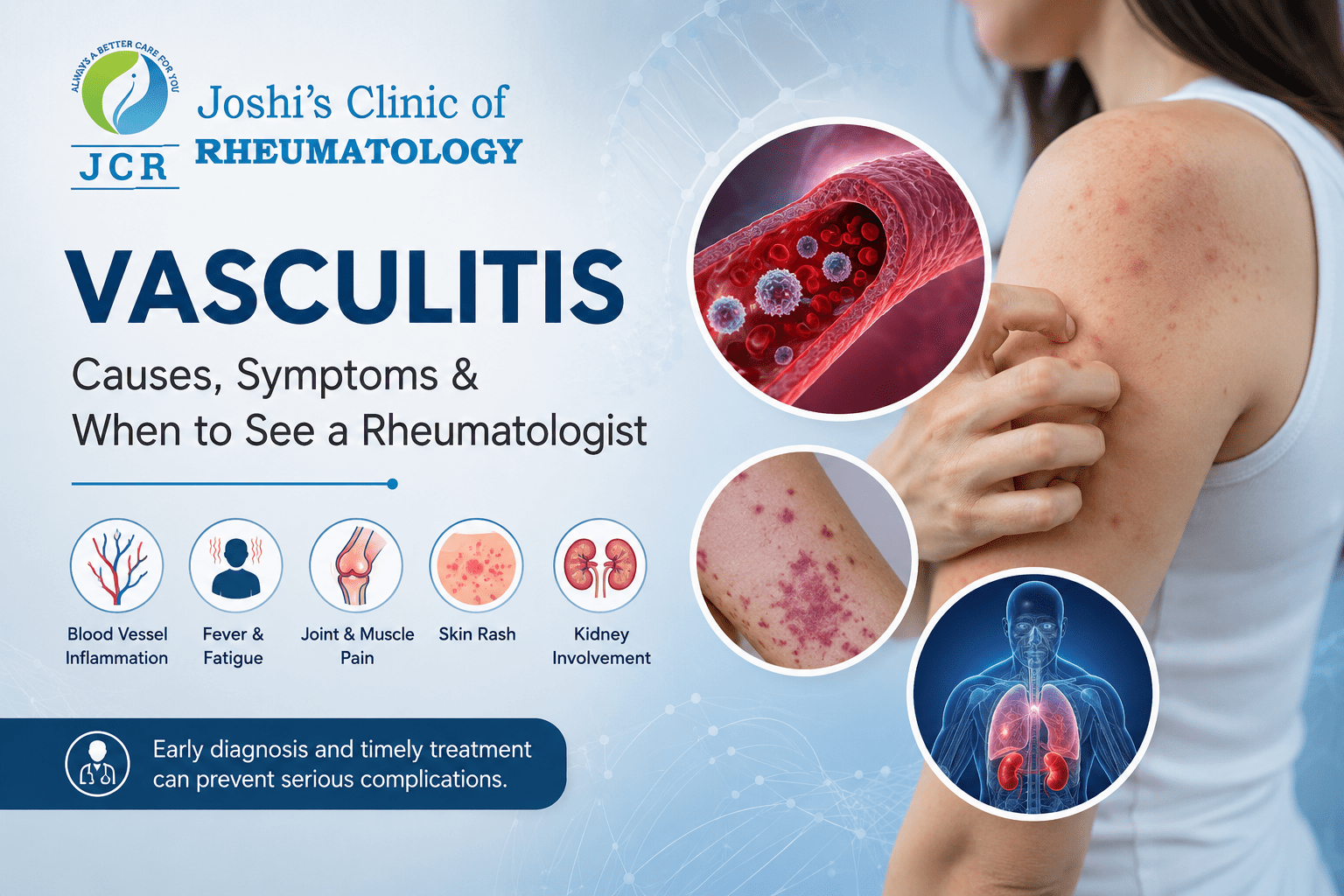
It usually starts with something small. A rash on the legs that comes and goes. A fever that will not settle. Joint pain that feels like the flu, except the flu should have been over weeks ago. Most people take these symptoms to a general physician first, then maybe a dermatologist for the rash, then perhaps an orthopaedic for the joint pain. Each specialist treats the piece in front of them, and each treatment offers only partial relief. What almost nobody considers early on is that all these symptoms could be coming from one single source, the blood vessels themselves.
This is vasculitis, and it is one of the most commonly missed diagnoses in general practice, simply because vasculitis symptoms mimic so many other conditions. This guide breaks down vasculitis causes, the warning signs to watch for, how vasculitis diagnosis actually works, and what vasculitis treatment looks like once the right specialist is involved. Most importantly, it explains why seeing a rheumatologist for vasculitis early, rather than after months of bouncing between specialists, can prevent permanent organ damage.
Vasculitis is autoimmune blood vessel inflammation. In a healthy body, blood vessels carry oxygen and nutrients to every organ without obstruction. In vasculitis, the immune system mistakenly attacks the walls of these vessels, causing them to become inflamed, thickened, weakened, or narrowed. This restricts blood flow to whichever organs those vessels supply, and over time, that restricted blood flow can cause lasting damage.
Because blood vessels run through literally every part of the body, vasculitis can show up almost anywhere: the skin, the kidneys, the lungs, the nerves, the eyes, or the joints. This is exactly why it gets misdiagnosed so often. A patient with skin involvement gets treated by a dermatologist. A patient with joint pain gets treated by an orthopaedic. A patient with kidney involvement gets sent to a nephrologist. Nobody connects the dots until a rheumatologist looks at the full picture together.
There are many types of vasculitis, and doctors typically classify them by the size of the blood vessels affected.
Small vessel vasculitis affects the tiniest blood vessels, usually in the skin, kidneys, and lungs. This category includes ANCA vasculitis, which covers conditions like granulomatosis with polyangiitis and microscopic polyangiitis. ANCA vasculitis is driven by specific antibodies that attack small blood vessels, and it is particularly notorious for causing silent kidney damage before symptoms become obvious.
This category includes conditions like polyarteritis nodosa, which affects medium-sized arteries and can cause skin nodules, abdominal pain, and nerve involvement.
Large vessel vasculitis involves the biggest blood vessels in the body, such as the aorta and its major branches. Giant cell arteritis and Takayasu arteritis fall into this category, and they often present with headaches, vision changes, and jaw pain when chewing.
Rheumatoid vasculitis develops as a complication in people with long-standing rheumatoid arthritis, affecting the skin and nerves. Behçet’s disease and Kawasaki disease are two other recognised forms, each with a distinct pattern of symptoms.
Vasculitis symptoms vary enormously depending on which vessels and organs are involved, which is precisely why the condition is so easy to miss. Still, certain patterns come up again and again.
A vasculitis skin rash is one of the more visible clues, and it can look like small red or purple spots, raised bumps, or, in more severe cases, ulcers that do not heal. These marks are known medically as purpura, and unlike an allergic rash, they do not fade when you press on them. This is one of the simplest bedside checks doctors use when comparing vasculitis vs allergic rash, since typical allergic rashes blanch under gentle pressure. Among purple spots on skin causes, vasculitis stands out because these marks generally do not fade the same way.
Vasculitis fever fatigue is a common early combination, often mistaken for a lingering viral infection. The fever tends to be low-grade and persistent rather than sharp and short-lived, and the fatigue does not improve with rest the way ordinary tiredness does.
Aching joints and muscles, without the swelling and deformity typical of classic arthritis, often accompany vasculitis. This is frequently the symptom that sends patients to an orthopaedic first, when the actual cause lies in the blood vessels supplying the joint tissue.
Numbness, tingling, or weakness in the hands or feet can occur when vasculitis affects the nerves’ blood supply. This symptom is often dismissed as a pinched nerve or vitamin deficiency before the real cause is identified.
Chronic sinus congestion, nosebleeds, coughing, or shortness of breath can indicate vessel involvement in the lungs or upper respiratory tract, particularly in ANCA-associated vasculitis.
This is perhaps the most dangerous part of vasculitis. Vasculitis kidney damage can progress with almost no obvious symptoms in its early stages. Blood or protein may show up in the urine long before the patient feels unwell, which is why routine testing matters so much once vasculitis is suspected.
Vasculitis causes are not fully understood in every case, but doctors have identified several known triggers and associations.
Vasculitis in adults tends to develop gradually, with symptoms accumulating over weeks or months rather than appearing all at once, which adds to the diagnostic delay so many patients experience.
Vasculitis in adults is frequently mislabelled as a stress-related flare-up, a stubborn viral infection, or a minor skin allergy in its early stages. Patients often visit three or four different specialists before anyone considers that a single underlying condition connects the rash, the fatigue, the joint pain, and the low-grade fever. Each specialist treats the symptom within their own domain, offers partial improvement, and the patient moves on to the next complaint without realising these are pieces of the same puzzle.
This diagnostic delay is not due to carelessness. Vasculitis is genuinely rare and its presentation genuinely overlaps with far more common conditions. But delay has consequences, since ongoing, undetected inflammation in the blood vessels can quietly damage organs like the kidneys and lungs while symptoms remain vague on the surface.
Vasculitis diagnosis typically involves a combination of clinical evaluation and targeted testing, since no single test confirms it on its own.
A rheumatologist starts by piecing together the full symptom timeline, including skin changes, joint complaints, fevers, and any organ-specific symptoms, looking for a pattern that a single-specialty view might miss.
A vasculitis blood test panel usually includes inflammatory markers like ESR and CRP, along with more specific tests such as ANCA antibodies, which help identify ANCA vasculitis in particular. Complete blood counts and kidney function tests are also standard, since they can reveal early organ involvement before symptoms appear.
Since vasculitis kidney damage can be silent, urine tests checking for blood or protein are a routine part of the diagnostic workup.
CT scans, MRIs, or angiograms may be used to visualise blood vessels directly, particularly for large vessel vasculitis affecting the aorta or its branches.
A small tissue sample, often from the skin, kidney, or another affected organ, can confirm the diagnosis under a microscope by showing direct evidence of blood vessel inflammation.
Vasculitis treatment focuses on controlling inflammation, protecting organs from further damage, and achieving long-term remission.
Access to vasculitis treatment India patients can rely on has improved significantly in recent years, with rheumatologists now able to offer a combination of these therapies tailored to each patient’s specific type and severity of vasculitis, along with close monitoring to manage medication side effects over time.
Since a skin rash autoimmune disease presentation is so often confused with a simple allergic reaction, it helps to know the basic differences. Allergic rashes typically appear suddenly after exposure to a trigger, itch significantly, and blanch or turn pale when pressed. Vasculitis-related rashes tend to appear gradually, may be tender rather than itchy, and generally do not fade under pressure since the discolouration comes from blood leaking out of inflamed vessels rather than surface irritation. If a rash persists for more than a few days, recurs without a clear trigger, or is accompanied by fever, joint pain, or fatigue, it is worth having it examined by a specialist rather than treating it as a routine allergy.
You do not need every symptom on this list to warrant a consultation. If you notice any combination of the following, particularly if it has lasted more than two to three weeks, it is time to see a rheumatologist rather than continuing to treat each symptom separately:
Unexplained skin rash and joint pain occurring together is one of the strongest signals that a rheumatologist, rather than a dermatologist or orthopaedic alone, should be involved from the start.
The biggest risk with vasculitis is not the condition itself, since with proper treatment, most patients achieve long-term remission. The real risk is delay. Every additional month spent bouncing between specialists without a unifying diagnosis is a month where inflammation may be quietly affecting the kidneys, lungs, nerves, or eyes. Some of this damage, particularly to the kidneys, can be irreversible if it goes on long enough. This is why connecting the dots early, recognising that a rash, a fever, and joint pain might belong to the same underlying condition, matters as much as the treatment itself.
Finding the right rheumatologist for vasculitis often makes the difference between months of fragmented treatment and a clear, coordinated diagnosis. Dr. Joshi, a trusted vasculitis specialist in Navi Mumbai, takes a whole-patient approach rather than treating isolated symptoms, looking at the rash, the fatigue, the joint pain, and the lab results together to identify the underlying pattern that other specialists may have missed individually.
For patients who have already visited a dermatologist for a rash, an orthopaedic for joint pain, or a general physician for unexplained fever without lasting relief, Dr. Joshi’s practice offers exactly the kind of connected, specialist-led evaluation that vasculitis requires. From the initial consultation through blood work, imaging, and a personalised treatment plan, the goal is always the same: catch the pattern early, protect the organs at risk, and get patients back to feeling like themselves.
If you or a loved one has been dealing with a combination of unexplained rashes, fevers, fatigue, or joint pain that no single specialist has been able to fully explain, do not wait for the pieces to add up on their own. Book a consultation with Dr. Joshi in Navi Mumbai and get the coordinated evaluation that vasculitis needs.